What Restaurant Owners Must Know About Marketing

Sharing is caring!

Have you ever tried baking a cake with flour alone? Exactly. Just like the best recipes cannot be made with a single ingredient, the best restaurant marketing strategy cannot be executed with a single tactic.

With abundant information and hundreds of channels to utilize, marketing can overwhelm even the most experienced business owners. So it’s not surprising that restaurateurs are often confused about the most essential elements of marketing and how to implement them. If you want to successfully market your restaurant, it is necessary to understand the full marketing picture, also known as The Marketing Mix.

Since the 1960’s, marketing professionals have used The Marketing Mix as a managerial teaching method. The Marketing Mix describes the different aspects of a business that, when controlled, ensure customer needs are met. One of the first tasks in restaurant marketing is analyzing the restaurant based on this model. This is the first step in moving from an ad-hoc approach based on hunches to a strategic approach based on data. In this blog, we’ll discuss the 7 P’s that comprise The Marketing Mix and how you can effectively leverage your restaurant.

1. PRODUCT: what you’re selling.

restaurant product

A restaurant’s product goes beyond food. Product includes atmosphere, cleanliness, quality, and all other aspects of the customer experience. Think about each want and need of the customer so you can provide them with the experience they are looking for.

Ask yourself: What features, advantages or benefits do your products and services provide? What types of vendors are being used? Does your product align with your atmosphere? Are products and services being looked at objectively?

There is much to consider about what you’re offering. A quality product/experience is the most fundamental element of The Marketing Mix and without it, all else fails.

Think I’m exaggerating? Think again.

2. PRICE: the amount people are willing to pay.
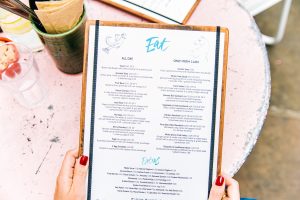
menu prices

Prices are always up for examination. It is vital to understand what type of restaurant you are: counter service, casual service, fine dining? The price of food is directly impacted by the style and stature of the restaurant.

Ask yourself: What type of restaurant do you have? What are your competitors charging? How do prices align with the current market?  How much is spent on resources and production? How much is the overall experience worth?

Price and quality coincide: prices must complement what is being offered. With a fluctuating marketplace, sometimes prices must decrease and sometimes prices must increase. Be open-minded and consider what the target consumers are willing to pay, what exactly they’re paying for, and if it’s reasonable.

Not sure where to start? Here is some advice on how to set appropriate prices.

3. PLACE: where the product or service is located.

Convenience is king, and customers will not go out of their way just to get in the door. Your product or service must be easily accessible to customers. Place also refers to outside placement and distribution.

Ask yourself: How convenient is your restaurant? Is there a central location and is it crowded? What is the parking like?  Can the products be delivered directly? Do we sell at a market or festival? Where are we advertising?

For more information on choosing the right location, click here.

4. PROMOTION: various elements like advertising and PR.

Promotion depends on the brand, product, and target audience in order to attract the desired customer base. Ranging from billboard ads to events, to social media, appropriate promotion methods are vital. Set a consistent tone for all promotional messaging that will resonate with the intended customer and evoke action.

Ask yourself: What discounts and specials are offered? Are promotions relevant, unique, and true to company values? What times of day are promotions occurring? What other social events are happening and how can these events be used advantageously? Lastly, are the promotional activities measurable?

Effective promotion depends on understanding the customer, the community, and the restaurant’s benefits. If promotional activities and messages are executed consistently with these aspects in mind, the brand will grow itself.

Here are tips to measure your restaurant’s promotional success.

5. PEOPLE: restaurant employees.

The product is linked to those who make and serve it; restaurant employees often define the customer experience.

Ask yourself: Are employees well-trained? Do they know the menu thoroughly? How do they interact with guests? Do they understand the company values and positively portray the brand?

Restaurant service is reproducible, but company culture sets service apart. A connected, communicative team is crucial in maintaining a hospitable environment and positive reputation.

Want advice on training employees? Look no further.

6. PROCESS: the efficiency of your restaurant.

Efficiency in the front and back of the house impact customer experiences and your brand. No one likes to wait around excessively; the customer must enjoy their experience from the second they enter the restaurant to the second they leave. A timely process is a part of what the guest is paying for and is what will keep them coming back for more.

Ask yourself: Do employees strive for efficiency? Are restaurant technologies up-to-date? Are there clear procedures put in place to ensure the consistent delivery of food and beverage? What is the standard wait time for each dish? Do staff know how to handle a customer complaint?

Answering these questions will lead to consistent timing and customer service, which are equally as important as product quality.

Do you need extra info on how to establish sound processes? You’re welcome.

7. PHYSICAL EVIDENCE: how inviting your restaurant is.

Physical evidence can be interchanged with the physical environment. Physical evidence is not only the appearance of the restaurant, but the look of your packaging, branding, and even the way the employees present themselves. Physical evidence is every surrounding detail.  Make it a point to regularly look around your restaurant and take it all in.

Ask yourself: What is the restaurant’s atmosphere? What is the vibe? How does the ambiance differ from day to night? How is the interior design affecting guests? What types of reviews are coming in? How does the food packaging represent the restaurant? What is the employee uniform like? What does food look like when it’s plated?

This will all be directly impacted by comfort, cleanliness, music, speed-of-service, and overall attention to detail.

Looking to improve your restaurant atmosphere? Look here for suggestions.

Marketing is frequently misinterpreted as an exclusively external process. The Marketing Mix shows why you must also control internal factors for marketing success. Advertising (one promotional marketing element) tells consumers why they should choose you, but the comprehensive Marketing Mix shows consumers firsthand why they should return. Marketers can only effectively do their job when there is sufficient understanding of The Marketing Mix. Products, prices, places, promotions, people, processes, and physical evidence must be regularly monitored by restaurant managers and owners. If you need further clarification on The Marketing Mix or any other restaurant marketing assistance, contact us at Absolute Marketing Solutions.

You Might Also Like:

Phoebe

A recent graduate from the University of Tampa, Phoebe brings an understanding of journalism, PR, advertising & branding to the Absolute team. Her extensive customer service and cross-cultural communication experiences give her insights into various perspectives.

More Posts

9 Reasons Why Your Restaurant Needs Public Relations

Sharing is caring!

“If I was down to my last dollar, I’d spend it on public relations,” – Bill Gates

Whether you were a fan of Entourage or Sex and the City, you’re probably familiar with television’s version of a publicist. Often portrayed as glamourous party planners and snarky celebrity wranglers, the importance of publicists and the public relations industry can be easily misunderstood. The reality is, PR is essential for any business, especially a restaurant.

What is Public Relations?
Public relations is the art of reputation management. PR professionals are experts at storytelling, persuading, and maintaining mutually beneficial relationships on clients’ behalf. A publicist’s main goal is to ensure that their clients are being positively portrayed and discussed. Marketing strategists argue that PR is the most effective way to build a brand. When it comes to restaurants, brand recognition is paramount. To produce buzz about your restaurant you need good word of mouth marketing, which is a direct result of effective PR.

Understanding public relationsUnderstanding public relations

9 Aspects of PR That Will Optimize Your Restaurant’s Marketing Efforts:

  1. The foundation of PR is understanding. Publicists will work hard to understand every nuance of your business in order to accurately and usefully tell your story.
  2. PR generates news coverage, which boosts credibility and visibility for your restaurant.
  3. PR professionals have authentic relationships with media professionals, guaranteeing repeated media coverage – not just one and done.
  4. Publicists know what’s newsworthy, and what’s not. If your restaurant doesn’t have something newsworthy to offer, PR professionals can help generate something that is.
  5. PR pros are writers at heart. They’re always willing to help craft messages to represent your brand.
  6. PR specialists monitor and amend all negative attention (like bad customer reviews). They are experts at transforming unhappy customers into brand ambassadors.
  7. In the PR world, social media is taken seriously. From the photo to the message, to the time of day, each post is thoughtful and strategic.
  8. PR is not just about getting on the news, it’s about understanding industry trends and utilizing relevant social influencers. By implementing blogger programs, so-called “citizen journalists” will promote your restaurant to their specific audiences.
  9. All forms of coverage attained through PR are more sincere and less costly than traditional advertising.

Investing in public relations is investing in your brand. This list encompasses only the basics; PR services are highly strategic, in-depth, and targeted to specific business needs. If your restaurant needs help communicating with specific audiences, creating campaigns, or managing a crisis, then PR is a must.

If you want to discuss the PR possibilities for your restaurant or business, contact us today.

You Might Also Like:

Phoebe

A recent graduate from the University of Tampa, Phoebe brings an understanding of journalism, PR, advertising & branding to the Absolute team. Her extensive customer service and cross-cultural communication experiences give her insights into various perspectives.

More Posts

Creating the Right Culture for your Restaurant

Sharing is caring!

We all remember the sitcom Cheers, set in a Boston bar where “everybody knew your name.” Many of us have a restaurant or bar in which we feel at home. Something about the place brings us back time and time again. We may not be able to put our finger on it, but the reason is likely culture. It has been long understood that culture attracts customers. What has been less understood is how to cultivate a culture that works profitably for your restaurant.

WHAT IS CULTURE?

A buzzword as of late, the definition of culture is not always made clear. We believe that culture is the foundation of your brand and the way you demonstrate your values to both employees and customers. Culture can be good or bad; it is a purposeful, or accidental, representation of the interactions in your restaurant. Creating a valuable culture is more than a marketing tactic, it can impact every aspect of your business and stand the test of time. Culture involves everything from a restaurant’s vision and concept, to its language and style, and once established effectively has been proven to increase employee engagement, customer service, and profits- not marginally, but considerably.

WHY DOES CULTURE MATTER?

According to restaurant marketing specialist Alfred Goldberg, “culture influences how people make decisions as it establishes how we do things and why. Whether it’s a big strategic decision or an everyday task, culture ensures that everyone knows what is expected of them.” Culture, brand, and service coincide, together dictating the types of people that walk through the doors and whether or not they will return. It doesn’t matter how mouthwatering your food is, if your culture doesn’t shine, interest from employees and patrons will decline. According to a Gallup report, engaged employees are more likely to improve customer relationships, which results on average in a 20% increase in sales. Happy, engaged employees lead to happy, engaged, repeat customers. Now that we’ve established the importance of the right culture, let’s talk about creating it.

HOW CAN YOU CREATE THE RIGHT CULTURE?

Culture should be established by the highest level of authority; it is only effective when personified by owners and employees alike. According to Chris Edmonds, a best-selling author and culture expert, “leaders must create a culture where values – how people treat each other – are as important as results, every day.” Edmonds advises defining the desired culture by creating an organizational constitution. The constitution should detail the most important standards of service and behavior that support the restaurant’s overall purpose.

HOW CAN YOU RETAIN THE RIGHT CULTURE?

Defining the desired culture is the easy part. The hard part is upholding all choices and actions to your original standards. Keep culture in mind from the start; hire and fire based on your organizational constitution. Since it can be so challenging to develop the right culture, when a restaurant does so, people are quick to take notice. One Tampa-based restaurant corporation that has done so is Ciccio Restaurant Group.

CICCIO RESTAURANT GROUP CULTURE

If you’re in Tampa, you know Ciccio Restaurant Group. CRG began as one restaurant, with one concept, and a well-defined culture. Now, with ten different restaurants and counting, CRG has spread throughout Florida, with varying concepts, but the same culture that they started with. Senior Brand + Training Director, Tara O’Neill, described their culture with us in an interview:
Tara O’Neill

Describe your company culture in 3-5 words.
“Open-minded, imaginative, collaborative, approachable, generous.”

How are your employees impacted by your culture? How are your guests?
“First and foremost, I have to respectfully make a correction here… we don’t have employees. By definition, an employee is a person that is merely employed for wages or salary. We have a team. Our purpose as a team is to come together to achieve a common goal. What is our goal? Bringing great, affordable, real food to our communities.
Our team members are impacted by our culture every day. Our culture is one that not only accepts people as they are…we celebrate them… just as they are. In whatever form and from whatever walk of life, we believe that everyone has something unique to contribute. Part of our role is to help put them in a position where they feel passion, purpose, and where they can excel. When our team feels happy and inspired, that translates to our guests. And, we feel like our guests DO feel it. Particularly here in our home market of Tampa, the synergy along Howard Ave is amazing. It’s not always the norm that a restaurant group has fans. And, we feel so grateful and humbled by the fact that we do. It’s not something we take for granted. Not even for one day.”

How do you ensure that all CRG stakeholders are positively affected by culture?
“So, one of the things we pride ourselves on being is a company of partners. And this doesn’t just mean a bunch of outside investors. This means real partners in our locations, operating our restaurants and engaging daily with our teams and guests. Most, if not all, of our general managers are actually partners in our locations with shared ownership. Because of our collaborative nature, we want them to have a voice. And, because they are truly business owners, they have the opportunity to share in the wealth of all of our successes. Our team members are some of our most important stakeholders. We want to provide a place for our team members to grow, excel, and be able to build long-term wealth.”

Would you agree that CRG has created a positive reputation based on the culture?
“Absolutely! I think that we have been so fortunate not only in our home market of Tampa but in other markets that we’ve expanded to because of the deep-rooted culture in our team members that live it. We rely on them to carry the torch no matter where they work. And from a community perspective, part of our culture means continuing to pay our gratitude forward by giving back as much as we can.”

How does your culture keep a competitive edge? How do you keep everyone continuously engaged?
“Culture in and of itself to us isn’t about having a competitive edge. It’s about remaining true to who we are, and through our evolution, never forgetting to stay grounded and remember our reason. One of the biggest things we look for when we hire is whether or not the team member seems to be a cultural fit. That’s one of the most important things we can do from a recruiting standpoint. When people align with our values, the engagement happens organically. And from there, we just continue to nurture and celebrate the partnership.”

Although there is no single path to generating a culture that turns employees and customers into loyal fans, looking at successful brands like those owned by Ciccio Restaurant Group can offer some valuable lessons. Culture encompasses purpose, customer service, attitudes, and values, and it is up to the leaders of the company to decide what type of culture they want to put forth and how. These leaders must do more than decide, they must hold themselves accountable as equal team members and consistently act based on the values set.

We hope these tips help to ensure that your restaurant has the right culture. If you’d like more information on restaurant culture or how to align your culture with your digital marketing, sign up for our E-newsletter or contact us directly at Absolute Marketing Solutions.

You Might Also Like:

Phoebe

A recent graduate from the University of Tampa, Phoebe brings an understanding of journalism, PR, advertising & branding to the Absolute team. Her extensive customer service and cross-cultural communication experiences give her insights into various perspectives.

More Posts